Flying Into Orlando With a Service Dog: Relief Areas, Airport Rules and the Federal Forms
This page explains the law in general terms. It is not legal advice. For a specific situation, contact the agency listed on this site or an attorney.
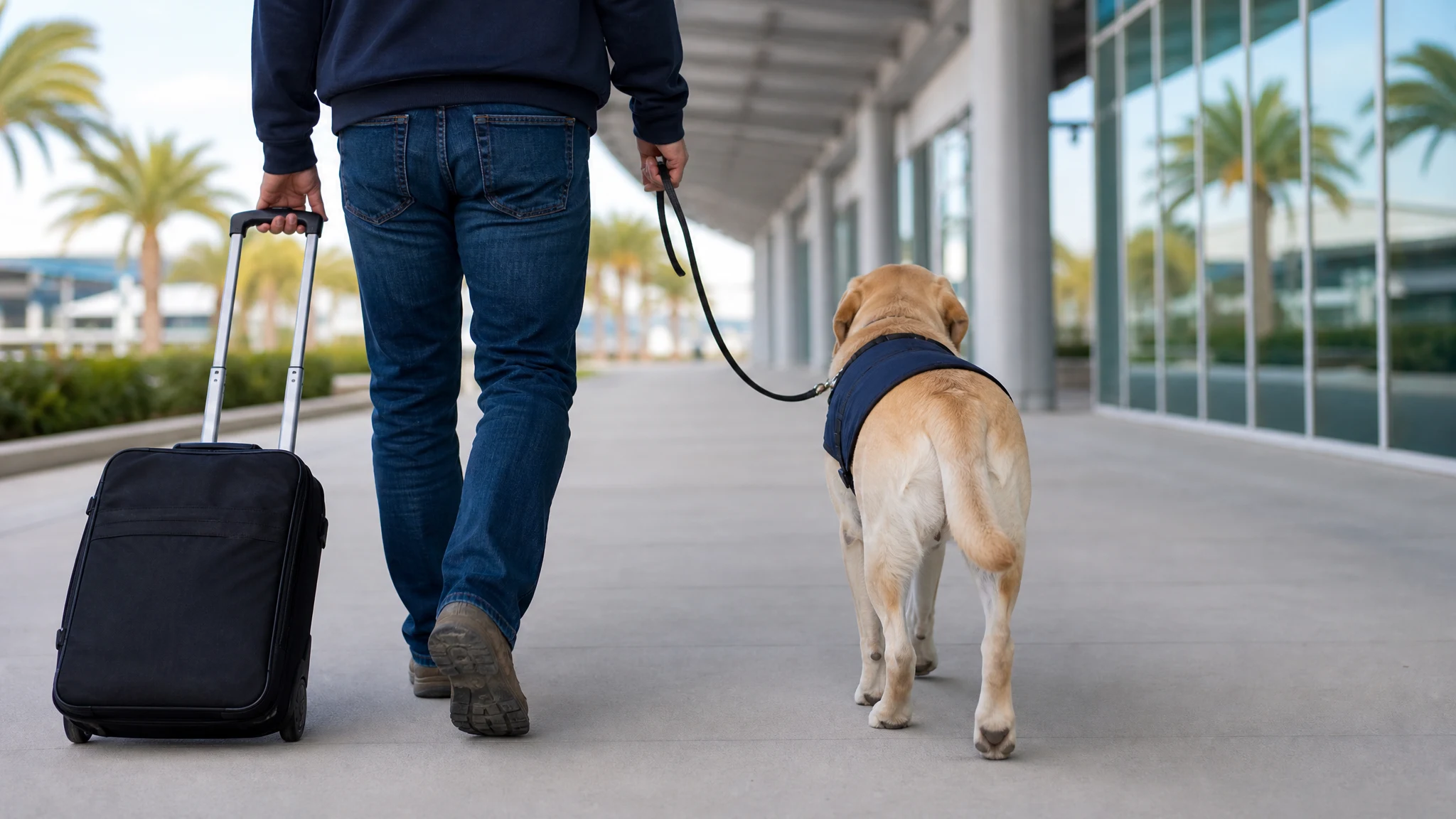
Florida's Orlando International Airport allows a service dog, but only a working one. The airport's own page says dogs are not permitted unless they are working dogs or are in a carrier approved for traveling on an aircraft, and it lists relief areas inside and outside security. This guide follows a trip from the car to the gate.
What Does the Orlando Airport Say About Service Dogs?
The Greater Orlando Aviation Authority's pets and service animals page says: "Dogs are not permitted in Orlando International Airport unless they are either working dogs, or they are in a carrier approved for traveling onboard an aircraft." The page is undated.
That means a dog in a vest is not automatically a working dog to the airport's eye. The ADA definition applies: a service animal is a dog individually trained to do work or perform tasks for a person with a disability, according to the ADA.gov service animals FAQ.
Where Are the Relief Areas?
The page lists service animal relief areas outside, at the North Cell Phone Lot, and inside the terminals.
Before security, they are at Terminal A Level 2 at the east end and Terminal B Level 2 at the west end. After security, they are on the wings for Gates 20-29, 40-49 and 90-99, across from Gate 121, and in Terminal C on Level 2 and Level 6 immediately before international bag claim.
A second list on the same page names slightly different gates in Terminal C.
Because the lists differ by one gate, this guide names the areas, not gate numbers. Check the airport's map before you travel, and plan a relief stop before you enter security. The page does not say how long the walk to each area takes, so build in extra time.
Numbered Steps From the Car to the Gate
The airport page supplies steps 1, 2 and 4. The federal forms in step 3 come from 14 CFR 382.75. The rest is this guide's suggestion.
- Use the outside relief area. The North Cell Phone Lot is the outdoor option the airport lists.
- Visit a pre-security relief area. Terminal A or B Level 2 is on the airport's list.
- Have the forms ready. The airline may require the U.S. Department of Transportation Service Animal Air Transportation Form.
- Plan an after-security stop. The airport lists areas on the wings and in Terminal C.
- Keep the dog under control. The handler is responsible for the animal's control at all times.
What Do the Federal Forms Require?
Under 14 CFR 382.75, a carrier may require a current completed DOT Service Animal Air Transportation Form. "Current" means completed on or after the date the passenger bought the ticket.
On a flight scheduled to take 8 hours or more, a carrier may also require a DOT Service Animal Relief Attestation Form, confirming the animal will not need to relieve itself or can do so without creating a health or sanitation issue.
The rule says a carrier may not require more documentation than those forms, with exceptions for transport rules of a federal agency, a U.S. territory or a foreign jurisdiction.
14 CFR 382.3 defines a service animal as a dog, regardless of breed or type, and says emotional support animals and service animals in training are not service animals for the purpose of that part.
What This Guide Does Not Cover
Several air-travel questions are not answered by the sources read. This guide does not state any airline's advance-notice deadline, TSA screening steps, size or foot-space rules, or a limit on the number of animals. Read the airline's own service animal page and TSA's page.
Florida's section 413.08 excludes air carriers covered by the Air Carrier Access Act from the state definition of a public accommodation. For flights, federal air rules apply. For other parts of the trip, the Florida service dog laws guide explains the state's rules.
Coming From Another State or Country
A dog entering Florida has to meet the state's rabies proof rule. The guide to moving to Florida with a service dog covers FDACS requirements, which are a separate question from airline forms.
Getting Around After Landing
SunRail serves parts of Central Florida, and its own rule is that service animals sit under the seat or at your feet. The guide on riding SunRail and JTA with a service dog compares those rules. The Orlando page does not describe ground transportation rules, so none are stated here.
Hurricane Season and Flights
The Atlantic hurricane season runs from June 1 to November 30, with a peak from mid-August to late October, according to the Florida Climate Center. Flights can be delayed or cancelled in a storm, and a service dog depends on its handler to have food, water and a relief plan during long waits. The hurricane season training calendar covers preparation.
Training for the Terminal
An airport is noisy and crowded. A dog that will work there needs a reliable settle, a loose leash and calm around rolling bags. A handler who is also building psychiatric tasks may pair this with a step-by-step path to psychiatric service dog skills, practicing the settle at quieter public places first. Any health or behavior concern goes to a veterinarian.