Service Dogs and In-Training Dogs on a Florida Public University Campus: The UF Policy
This page explains the law in general terms. It is not legal advice. For a specific situation, contact the agency listed on this site or an attorney.
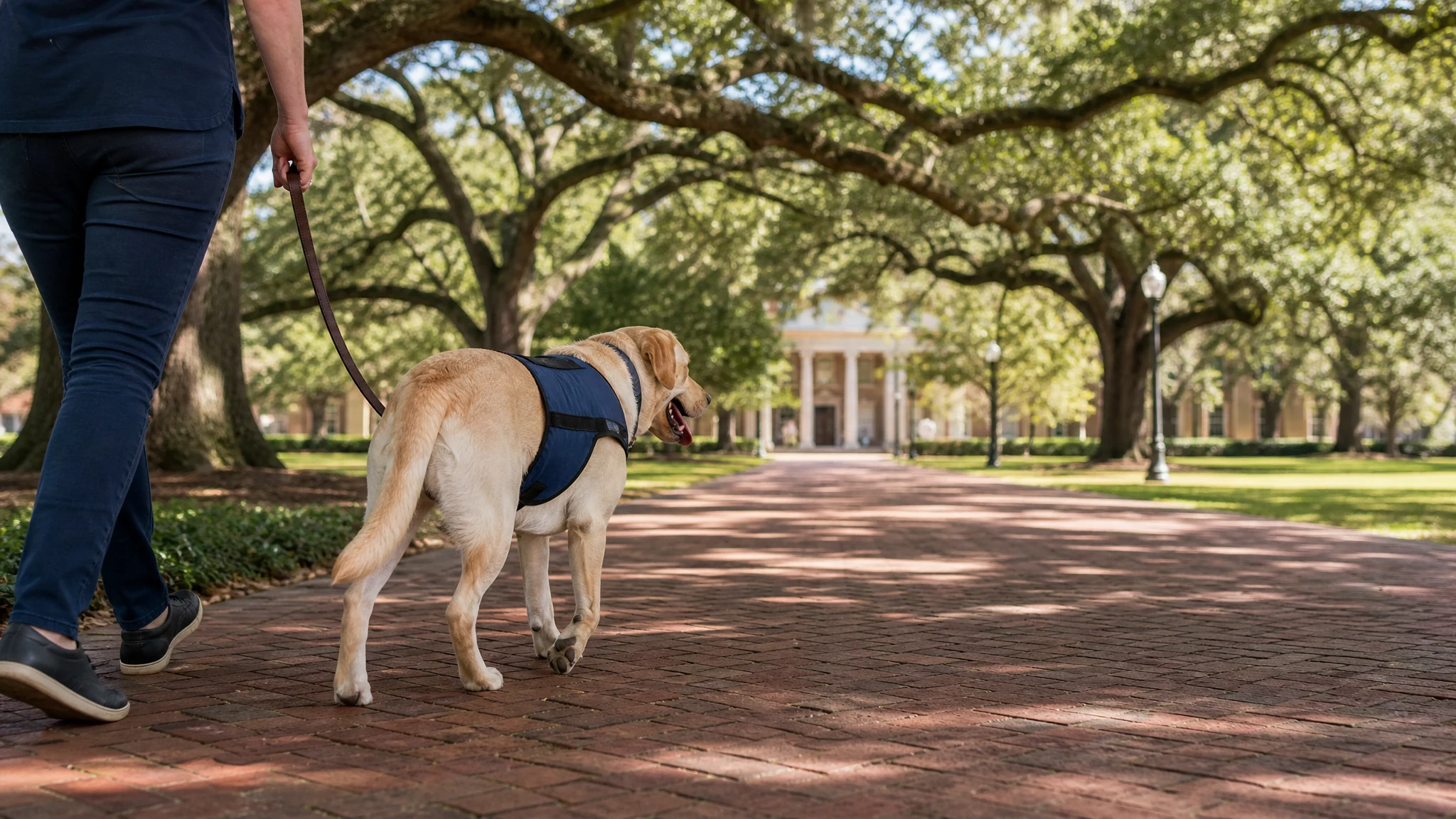
A service dog on a Florida public university campus follows the school's written policy as well as the law. The University of Florida's Policy 5-006 says a service dog may go where other students may go, lets dogs in training into general outdoor areas "in accordance with state law," and leaves access beyond that to its ADA Compliance Office.
What Does the University of Florida Policy Say About a Service Dog?
Policy 5-006 is titled "Service Animals, Service Animals in Training and Emotional Support Animals at UF." It is posted on the University of Florida's Regulation and Policy Hub. UF is a public university, so it falls under Title II of the Americans with Disabilities Act (ADA). The effective date of the policy was not captured, so check the hub for the current version.
The policy applies to UF and its direct-support organizations, not to UF Health. It cites the ADA, Section 504, the Fair Housing Act and Florida Statutes s. 413.08. Other Florida public universities have their own policies, and this guide did not read them.
Where Can a Service Dog Go on Campus?
Under Title II, students with service animals may be accompanied "in any place where other students in UF programs, activities or services are allowed," except in limited situations. Questions go to the Disability Resource Center for students and to the UF ADA Compliance Office for employees and third parties.
The policy also says UF "does not require Service Animals to wear an identifying vest, collar, or badge." That matches the ADA.gov service animals FAQ, which says the ADA does not require a vest, ID tag or specific harness.
UF may remove an animal that is a direct threat, causes damage or significant disruption, is aggressive, is not housebroken, or whose handler does not keep effective control. These are UF's own words about its rules, and they are broader than the federal list, so read the policy before a dispute.
Service Dog in Training, and Emotional Support Animal, Compared
| Category | What the UF policy says |
|---|---|
| Service animal | Handler may go where other students may go, with limited exceptions |
| Service animal in training | "In accordance with state law, Service Animals in Training and their Handlers are permitted in General Outdoor Areas." Access beyond those areas "is at the discretion of the UF ADA Compliance Office" |
| Emotional support animal | Requests "are only available in connection with UF housing" |
The policy says an animal in training does not qualify as a service animal under federal law. That is consistent with the ADA.gov FAQ, which says "the dog must already be trained before it can be taken into public places" under the ADA and that some state or local laws may cover animals in training.
What Does State Law Say About Trainers?
The state side is section 413.08(8): "Any trainer of a service animal, while engaged in the training of such an animal, has the same rights and privileges with respect to access to public facilities." The trainer is liable for damage as in subsection (3). The statute as read sets no age limit and no ID requirement for trainers.
The UF policy takes a narrower view on campus than that sentence suggests, since it limits the in-training handler to general outdoor areas by default. Which reading controls in a dispute is for a court or the agency to decide, and this guide does not predict. The longer discussion is in service dogs in training in Florida.
How Should a Student Team Plan a Semester?
These steps are this guide's suggestion.
- Read Policy 5-006 and note which office handles your situation.
- Contact the Disability Resource Center as a student, or the ADA Compliance Office as an employee or visitor, before the first day.
- If the dog is still in training, ask the ADA Compliance Office in writing which areas beyond general outdoor spaces are open.
- Practice routes from housing to class with the dog at heel, so the first week is routine.
- Keep the dog's health and vaccination records current. A dog's health or behavior concern goes to a veterinarian.
Reasoning, not a policy statement: a Florida campus gives a training team constant distraction, which suits the practice walks that build focus.
Weather belongs in the plan too. The Florida Climate Center says "Virtually all summer rainstorms are accompanied by thunder and lightning," and the National Weather Service Melbourne office says "When thunder roars, go indoors -- and stay there for 30 minutes after the last clap of thunder." A route between classes should include indoor stops.
If a student's dog is learning psychiatric tasks, a stepwise course in psychiatric service dog work can give the team a structure for the months before and during a semester. The campus policy still decides where an in-training dog can go.
What Else Might a Student Need?
A student who needs to appear in court should see service dogs in Florida courtrooms. A parent of a school-age student will want service dogs in Florida public schools. A student without a car may ride the commuter rail in Central Florida, covered in riding SunRail and JTA with a service dog.
Campus policy is the document to read first. A student with a service dog has the ADA behind the dog, and a student with an in-training dog has a policy that grants general outdoor access by default.