Service Dog Tasks and the Public Access Test, Explained
This page explains the law in general terms. It is not legal advice. For a specific situation, contact the agency listed on this site or an attorney.
Two questions come up again and again for Florida handlers and owner-trainers. What counts as a task? And what is the public access test?
The first is a legal question. The second is a training question. People often mix them up, and that causes real confusion at store doors, in apartment offices and in training plans.
This guide separates the two. It explains what the ADA and Florida law say about service dog tasks, then walks through how to build tasks and use a public access test as a practice benchmark.
What counts as a task under the law
The ADA.gov Service Animals FAQ defines a service animal as a dog that has been individually trained to do work or perform tasks for a person with a disability. The task must be directly related to the person's disability.
Florida uses a similar idea. Section 413.08, Florida Statutes, defines a service animal as an animal trained to do work or perform tasks for an individual with a disability. That can be a physical, sensory, psychiatric, intellectual or other mental disability. For the public access subsections, the statute limits the term to a dog or miniature horse.
Two phrases do the work here: individually trained and directly related to the disability. A dog that is friendly, calm or good company does not meet that test on those traits alone.
Why comfort alone is not a task
Section 413.08(1)(d) says emotional support, comfort or companionship does not count as work or tasks. The ADA draws the same line. Emotional support, therapy and comfort animals are not service animals under the ADA.
This does not mean a service dog cannot be comforting. It means comfort is not what makes the dog a service dog. The trained response is.
- Sitting close because the handler feels better is comfort.
- Interrupting a panic episode on a trained cue, such as nudging or pressing against the handler, is a task.
What tasks can a service dog do?
The law does not publish a complete list, and it does not need to. Any trained action that directly relates to a person's disability can qualify. The examples below show the range. They are illustrations of the kind of work handlers and trainers describe, not an official list.
Mobility and physical disabilities
- Retrieving dropped items, keys or a phone
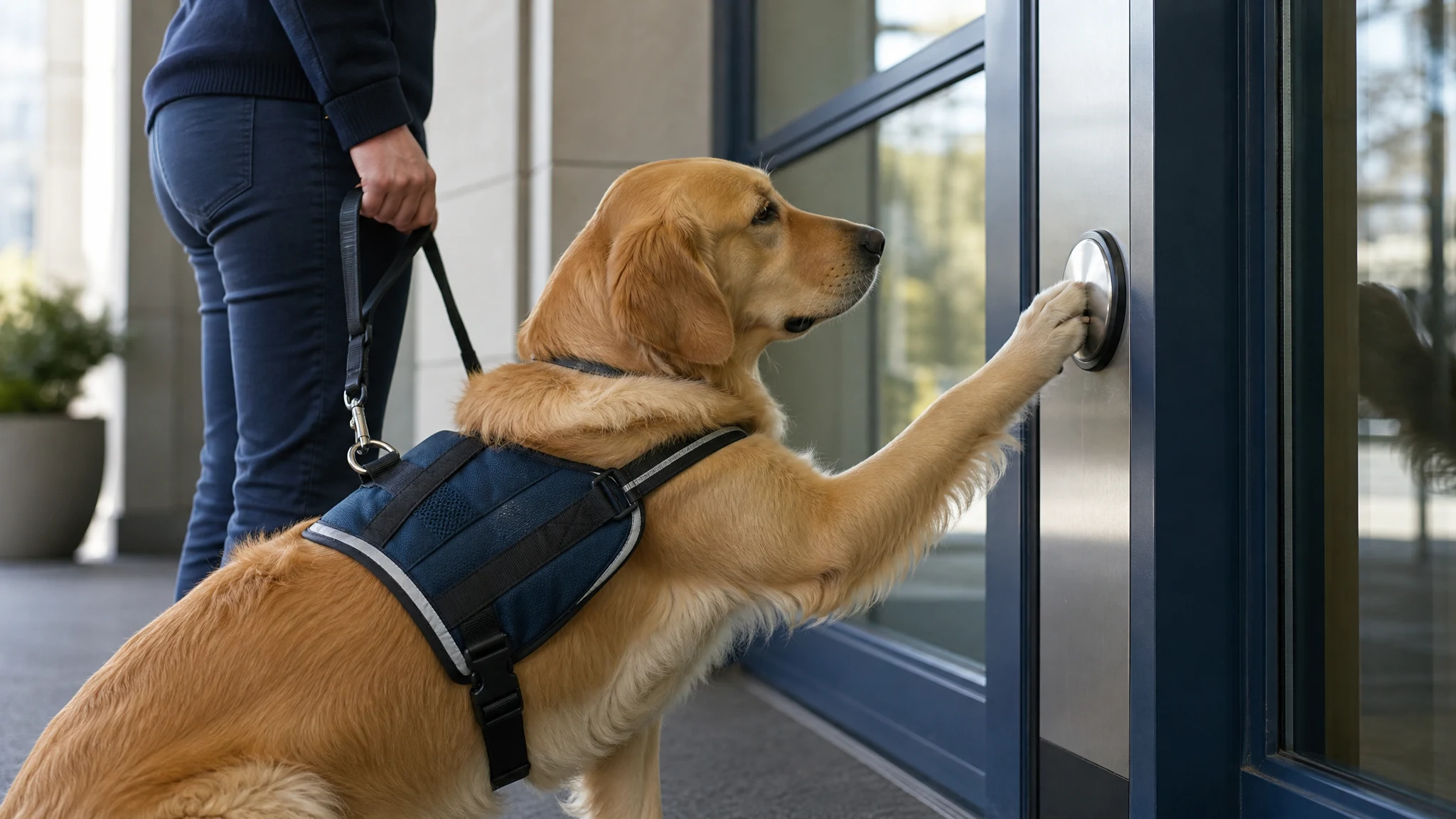
- Opening and closing doors or drawers with a tug strap
- Providing counterbalance or bracing on a trained cue
- Turning light switches on and off
Hearing and sensory disabilities
- Alerting to a doorbell, alarm, name call or approaching sound
- Guiding a handler who is blind or has low vision around obstacles
Medical conditions
- Alerting a handler to an oncoming medical event, where the dog has been trained to do so
- Responding to a seizure by fetching help, staying close or activating an alert device
- Reminding a handler to take medication at set times
Psychiatric disabilities, including PTSD
- Interrupting repetitive or self-harming behaviors
- Creating space in a crowd by standing or positioning behind or in front of the handler
- Turning on lights and checking a room on cue
- Waking a handler from a nightmare
Autism and other developmental disabilities
- Interrupting a repetitive behavior on cue
- Staying with and tethering to a child to reduce bolting, with the setup planned with the family's care team
Whatever the disability, the pattern is the same: a specific cue or trigger, a specific trained response, and a clear link to what the disability makes difficult.
What the public access test is, and what it is not
A public access test is a practical checklist of behaviors. It checks whether a dog stays under control and well-mannered around people, noise, food, other animals and busy spaces. Assistance Dogs International (ADI) is the organization whose standards many assistance dog programs use as their benchmark. Dogs For Life in Vero Beach, for example, says on its own site that it is an accredited member of ADI.
Here is the part that matters legally. The ADA does not require a service dog to pass a public access test. The ADA.gov FAQ does not call for any test, certificate or registry, and neither does Florida law. Section 413.08(3) says documentation that the animal is trained is not a precondition for service.
So the test is a training benchmark, not a license. Use it to measure your dog's readiness and find gaps. Do not present it, or any certificate from an online seller, as legal proof. There is no official service dog registry or required certification under the ADA, and Florida has no state ID, tag or registry either.
Handlers still have responsibilities. Under the ADA, a business may remove a dog that is out of control when the handler does not take effective action, or that is not housebroken. A well-prepared dog avoids those situations.
Materials you will need
- A dog that is healthy, sound in temperament and old enough to train for public work
- Small, soft, high-value treats and the dog's regular meals for reward
- A flat collar or a well-fitted harness, and a standard six-foot leash
- A marker, either a clicker or a consistent word such as "yes"
- A portable mat for settling in public
- A notebook or app for a training log
- A phone to film practice sessions
- A trusted helper for distraction work
- A written list of the specific tasks your dog is being trained to do
Step-by-step: building tasks and preparing for the test
Step 1. Name the disability-related need
Start with the person, not the dog. Write down what the disability makes difficult or unsafe each day. Then ask what a dog could physically do to reduce that difficulty.
A need such as "helps with anxiety" is too vague to train. "Interrupts hand-scratching by nudging my arm" is something you can teach.
Step 2. Test each task against the definition
For every item on your list, ask two questions. Is it a specific trained action the dog performs on a cue or trigger? Is it directly related to the disability?
If the answer to either is no, it is probably companionship or comfort. Keep it as a nice trait, but do not count it as a task.
Step 3. Teach each task with rewards
Use humane, reward-based methods, in line with the American Veterinary Society of Animal Behavior (AVSAB). Lure, capture or shape the behavior, mark the moment it is right, and pay with a treat.
Train in small steps. Add the cue only after the dog does the behavior reliably. Add duration, distance and difficulty one at a time.
Do not use shock, prong or choke collars, alpha rolls, scruffing or dominance methods. They add fear and conflict, and they work against the calm, confident dog you need in public.
Step 4. Make each task reliable in new places
A dog that retrieves in the living room may fail in a parking lot. Practice each task in the kitchen, the yard, a quiet hallway, and then a calm public place with permission.
Raise one challenge at a time: distance from you, duration, then distractions. If success drops, go back one step.
Step 5. Build the basic public manners
These are the foundation of most public access checklists. Teach them as separate skills:
- Loose-leash walking without pulling
- Sit, down and stay, with a settle on a mat
- Coming when called, including away from distractions
- Ignoring dropped food and food on tables
- Staying calm around other dogs, carts, doors and elevators
- Entering and exiting doorways and vehicles on cue
- Waiting quietly while you talk, pay or sit
- Staying relaxed when strangers approach or touch the equipment
Step 6. Practice a mock public access test
Ask your helper to run through realistic situations while you film. A typical practice session might include:
- Walking through a crowd without sniffing, pulling or lunging
- Sitting calmly while someone drops a pan lid or a bag
- Settling under a chair or table for ten minutes or more
- Passing a plate of food without interest
- Meeting a stranger without jumping or fixating
- Ignoring another dog at a reasonable distance
- Performing one of the dog's real tasks on cue in the middle of all this
For the official test items and scoring, check the published standards of ADI or of the program whose benchmark you are following. Do not guess at them.
Step 7. Review, log and repeat
Watch the footage. Look for signs of stress such as lip licking, yawning, avoidance, a tucked tail or sudden stillness. A dog that is only coping is not ready.
Write down what went well and what did not. Return to an easier setting for any skill that slipped, then retest.
Know your rights and limits in Florida
Under Section 413.08, public accommodations must modify policies to permit service animals. The handler may be accompanied by the animal in all areas open to the public or customers. Staff may not ask about the nature or extent of the disability.
Under the ADA.gov FAQ, when the need for the dog is not obvious, staff may ask only two questions. Is the dog a service animal required because of a disability? What work or task has the dog been trained to perform?
Florida also protects people who are training. Section 413.08(8) gives a trainer of a service animal, while engaged in training, the same access rights and liability for damage as a person accompanied by a service animal. The statute as written sets no age limit and no ID requirement for trainers.
On the other side, Section 413.08(9) makes it a second degree misdemeanor to knowingly and willfully misrepresent oneself as using a service animal, as qualified to use one, or as a service animal trainer. The penalty also includes 30 hours of community service completed within six months. Pretending a pet is a service dog harms real handlers.
For a broader look at Florida law, programs and costs, see our guide to service dog training in Florida: laws, programs and costs.
Tips and common mistakes
- Calling comfort a task. If the dog is only present, it is not a task. Train a specific action.
- Buying a certificate or registration. It carries no legal weight under the ADA or Florida law. Spend the money on training time instead.
- Skipping the boring skills. Many dogs with excellent tasks fail in public because they cannot settle.
- Moving too fast. Pushing into busy places before the dog is ready can create fear that is hard to undo.
- Treating the test as pass or fail on one day. Dogs have off days. Look at the trend across several sessions.
- Ignoring the dog's welfare. A dog that is stressed, tired or in pain should rest. Check any health or behavior concern with your own veterinarian.
- Training without a plan. Written task lists and a training log keep you honest about what the dog can actually do.
What to expect
Task training often takes many months, and public reliability can take longer. Timelines vary a great deal with the dog, the tasks and the handler's experience, so no one can promise a specific result.
With consistent, reward-based practice, many dogs become more settled and more dependable in public settings. Progress is rarely a straight line. Expect plateaus, and expect to revisit earlier steps.
If you would like professional help, Florida has several assistance dog organizations. Check each program's own site for eligibility, cost and waitlists, because those details change.
Where to take a complaint
This article states the law in plain terms and is not legal advice. If you believe you were denied access or housing because of a service dog, the Florida Commission on Human Relations takes discrimination complaints involving employment, housing and public accommodations. The ADA.gov Service Animals FAQ also explains how to file a complaint at the federal level.