Alligators and the Water's Edge: Walking a Service Dog Beside Florida Ponds and Canals
This page explains the law in general terms. It is not legal advice. For a specific situation, contact the agency listed on this site or an attorney.
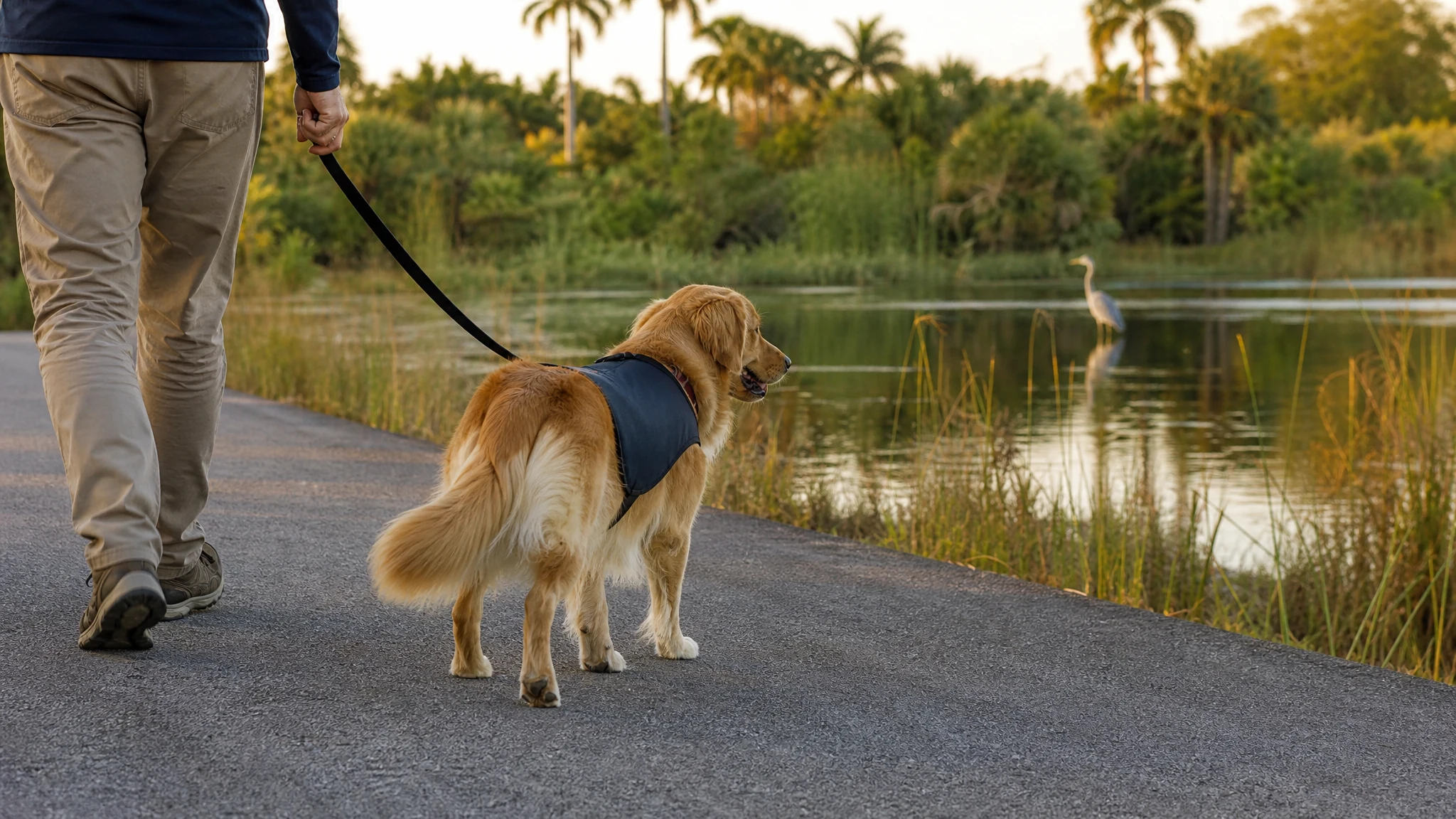
A service dog handler in Florida can meet an alligator almost anywhere there is fresh or brackish water. The Florida Fish and Wildlife Conservation Commission (FWC) says alligators live in all 67 counties and tells walkers to keep dogs on a leash and away from the water. This guide turns that advice into a walking routine.
What Does FWC Say About Dogs and Alligators?
FWC's alligator page says "Serious injuries caused by alligators are rare in Florida." It also says to swim only in designated swimming areas during daylight hours and to "keep pets on a leash and away from the water."
FWC's pets and wildlife page is more specific. It says to walk dogs on non-retractable leashes that are 6 feet or less, "especially at night, dusk or dawn."
It says to avoid walking pets next to the water's edge of ponds, lakes, rivers, wetlands or other fresh or brackish water bodies, and not to let them swim there. Alligators "are found throughout Florida in these water bodies and are not always visible."
Which Florida Places Raise the Stakes for Alligator Safety?
The National Park Service's Everglades safety page says alligators and crocodiles "may perceive animals like small dogs as prey," advises staying at least 15 feet away, and says "If an animal is hissing, you are too close." It adds that alligators and crocodiles are more active at night and do most of their hunting from dusk to dawn.
The same page says mosquitoes are more prevalent on overcast days and at dusk and dawn, especially during the summer, so a dusk walk near water carries two hazards at once. It also says pets are not allowed on most trails there and advises against leaving a pet in a parked car.
That page is about one national park. The principle, a dog near water at dusk is the riskiest combination, comes straight from FWC's wording for the whole state. The Everglades and Big Cypress guide covers what those parks say about service dogs on trails.
A Numbered Route Plan for Water-Adjacent Walks
Steps 1 to 3 restate FWC's advice. Steps 4 to 6 are this guide's reasoning about training and routes.
- Pick the route. Choose a path set back from the water's edge. FWC says to avoid walking pets next to the edge of ponds, lakes and canals.
- Choose the leash. Use a non-retractable leash of 6 feet or less, as FWC advises.
- Choose the time. Walk in daylight when you can. FWC names night, dusk and dawn as the times to be most careful.
- Teach the "leave it" and "this way" cues. Practice them on a dry path with a reward, before you rely on them near water.
- Teach a calm stop. The dog should halt and look at you when you say a cue, so you can turn and leave.
- Walk away. If you see an alligator, put distance between it and the dog without hurrying toward the water.
What to Do If You See an Alligator
The Everglades page says to keep a distance of at least 15 feet. FWC's Nuisance Alligator Hotline is 866-392-4286, which spells 866-FWC-GATOR, for a nuisance alligator.
Beyond that, this guide does not give a sourced procedure for an encounter, because the pages read do not give one. Treat the above as the floor, and ask FWC or the park for more.
If a dog is bitten or injured by wildlife, FWC says to contact a veterinarian. Do not wait to see whether the injury is serious.
Why a Tether or Chain Is a Different Question
FWC says "Chained or tethered pets are more vulnerable to conflicts with wildlife that could lead to serious injury or death" and points to county and city tethering laws. That sentence is about pets left tied outside, not about a service dog on a handler's leash.
A handler's leash is held, and the handler can move away. A dog tied in a yard near a pond cannot. If your home backs onto water, the FWC advice about keeping dogs away from the water's edge applies to your yard too.
Training the Dog to Ignore the Pond
This section is reasoning. Reward-based training only: reward the dog for looking at you, for walking beside you, and for ignoring the water. Never use shock, prong or choke collars, and do not punish a dog for noticing an animal.
A dog that lunges toward water, birds or turtles is telling you the exercise is too hard.
In a Florida neighborhood with retention ponds and canals, that can happen on an ordinary block, so rehearse the cues on the routes you use every day. Back up to a quieter place and shorten the session. A dog with sudden behavior changes should see a veterinarian, and an aggressive dog needs a veterinarian plus a certified behavior professional.
The step-by-step owner-training plan for Florida shows where this kind of work fits. A handler who wants to add psychiatric tasks can use step-by-step coursework for psychiatric tasks alongside it.
Water Hazards Beyond Alligators
Water in Florida carries other risks. The red tide and blue-green algae checklist covers what the Florida Department of Health and FWC say about algae, and the heat walking plan covers summer walks.
A canal or pond that looks calm can be home to several hazards at once. A dry path with a short leash handles most of them.